St Andrews Cathedral
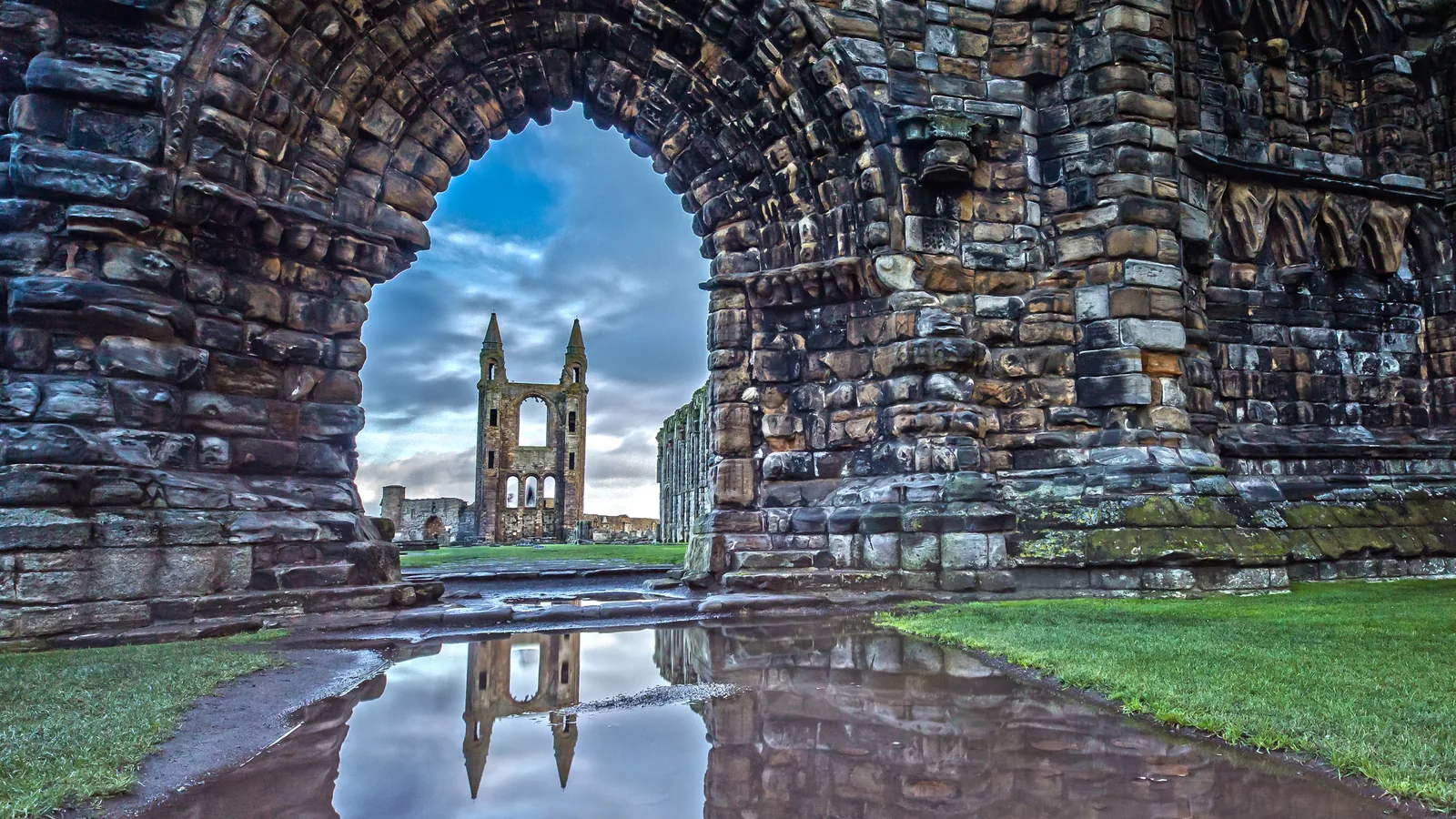
St Andrews Cathedral is the ruin of what was once Scotland's largest church, on the headland above the harbour. The grounds are free to wander, and a free guided tour finishes with a climb up the 33-metre St Rule's Tower for views across the town, the bay and the coast.
Photos
Andy Hawkins · Wikimedia Commons
A short history
St Rule's Church came first, probably around 1130, built for the Augustinian canons. Bishop Arnold began the great cathedral beside it around 1160, but a storm that brought down the west front in 1272 and the Wars of Independence slowed the work. It was finally consecrated in 1318 with Robert the Bruce present, and became the headquarters of the Scottish Church. After John Knox preached in the town in 1559 the building was stripped, and by 1561 it had been abandoned to decay.
What to see
The east gable, which once housed the relics of St Andrew, still stands to its full height, along with parts of the west front and the long precinct wall. St Rule's Tower, older than the cathedral itself, is the square landmark you'll spot from the beaches. The graveyard is full of character, though parts are fenced off where old headstones have become unstable.
Planning your visit
Allow an hour for the grounds, longer if you join a tour. The site is run by Historic Environment Scotland and opening is seasonal, with fewer days in winter. The on-site museum is currently closed for maintenance. St Andrews Castle is a few minutes' walk along the cliffs, and Castle Sands and the harbour sit just below.
Highlights
- Ruins of Scotland's largest medieval church
- St Rule's Tower, 33 metres tall
- Free entry to the grounds
- Free guided tours ending with a tower climb
- Consecrated in 1318 in the presence of Robert the Bruce
Good to know
- Tower climbs come at the end of the free guided tours; phone St Andrews Castle on 01334 477196 to check times.
- Opening is seasonal: daily in summer, Friday to Monday in winter.
- The cathedral museum is closed for essential maintenance.
- Some graveyard areas are fenced off for safety.
Frequently asked questions
Nearby
Sources: historicenvironment.scot · historicenvironment.scot