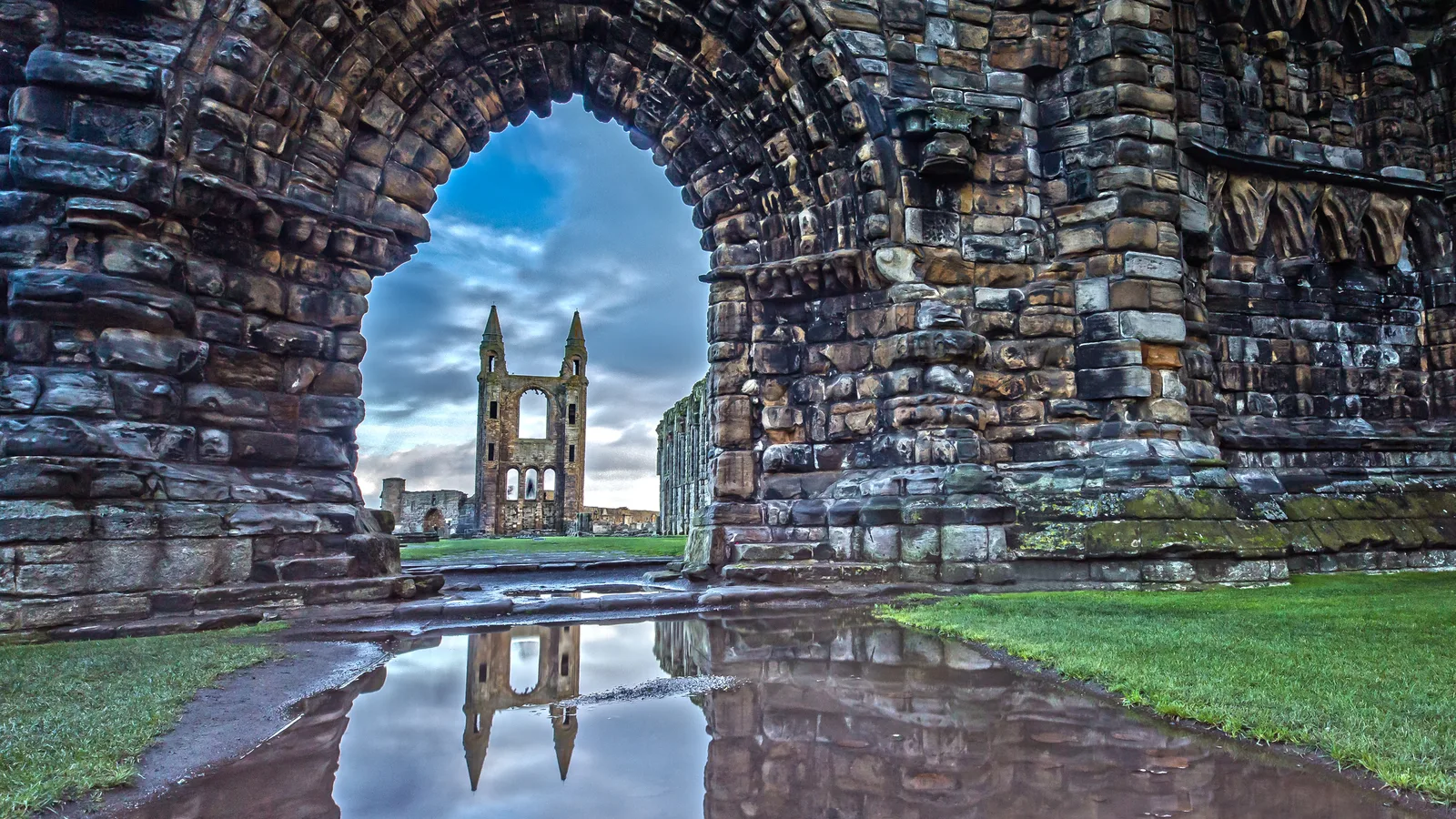
Weekend
St Andrews beyond the golf: a long weekend of ruins, quads and beaches
Skip the tee times. Our long weekend in St Andrews takes in a clifftop castle, Scotland's largest medieval church, Scotland's oldest university and two very different beaches.
By VacationGuide Editors · · 6 min read
St Andrews has a reputation that arrives before you do. Say the name and most people picture a links fairway and a stone bridge. That's fair, but it's only half the town. The other half is a medieval cathedral open to the sky, a clifftop castle with a dungeon cut from solid rock, Scotland's oldest university wrapped around quiet quads, and two very different beaches either side of the harbour. This is our plan for a long weekend that barely touches a golf club, and doesn't miss it.
Friday evening: get your bearings on the Scores
Arrive late afternoon, drop your bags and walk. The Scores runs along the clifftop above the sea, and it's the best introduction the town offers. Start at the Wardlaw Museum, the University of St Andrews' own museum at 7 The Scores. It has four galleries drawn from the university's collections of art, history, science and natural history, entry is free, and there's a terrace and garden looking out to sea. Even if you only have twenty minutes, step out onto that terrace.
From there, keep walking east and you'll reach the ruins of St Andrews Castle on its rocky promontory. Save the inside for the morning; for now, watch the light go over the water. Supper can be as simple or as smart as you like. The Jigger Inn, The Keys Bar and The Criterion all give you a pub table in town, while Amber St Andrews suits a sit-down dinner.
Saturday morning: castle, cathedral and a tower with a view
Begin at the castle. It was built around 1200 by Bishop Roger de Beaumont, and its story is darker than its postcard looks suggest. In 1546 the Protestant preacher George Wishart was burned at the stake in front of the walls; brick lettering marks the spot. Weeks later his supporters got into the castle disguised as masons and killed Cardinal David Beaton. The siege that followed produced the castle's most extraordinary feature: attackers dug a mine through solid rock, and the defenders dug a countermine to meet it. Both tunnels were rediscovered in 1879 and both are open to visitors today. Then there's the bottle dungeon, a pit cut into the rock beneath the north-west tower. Peer down and you'll understand why John Knox wrote of the people imprisoned there.
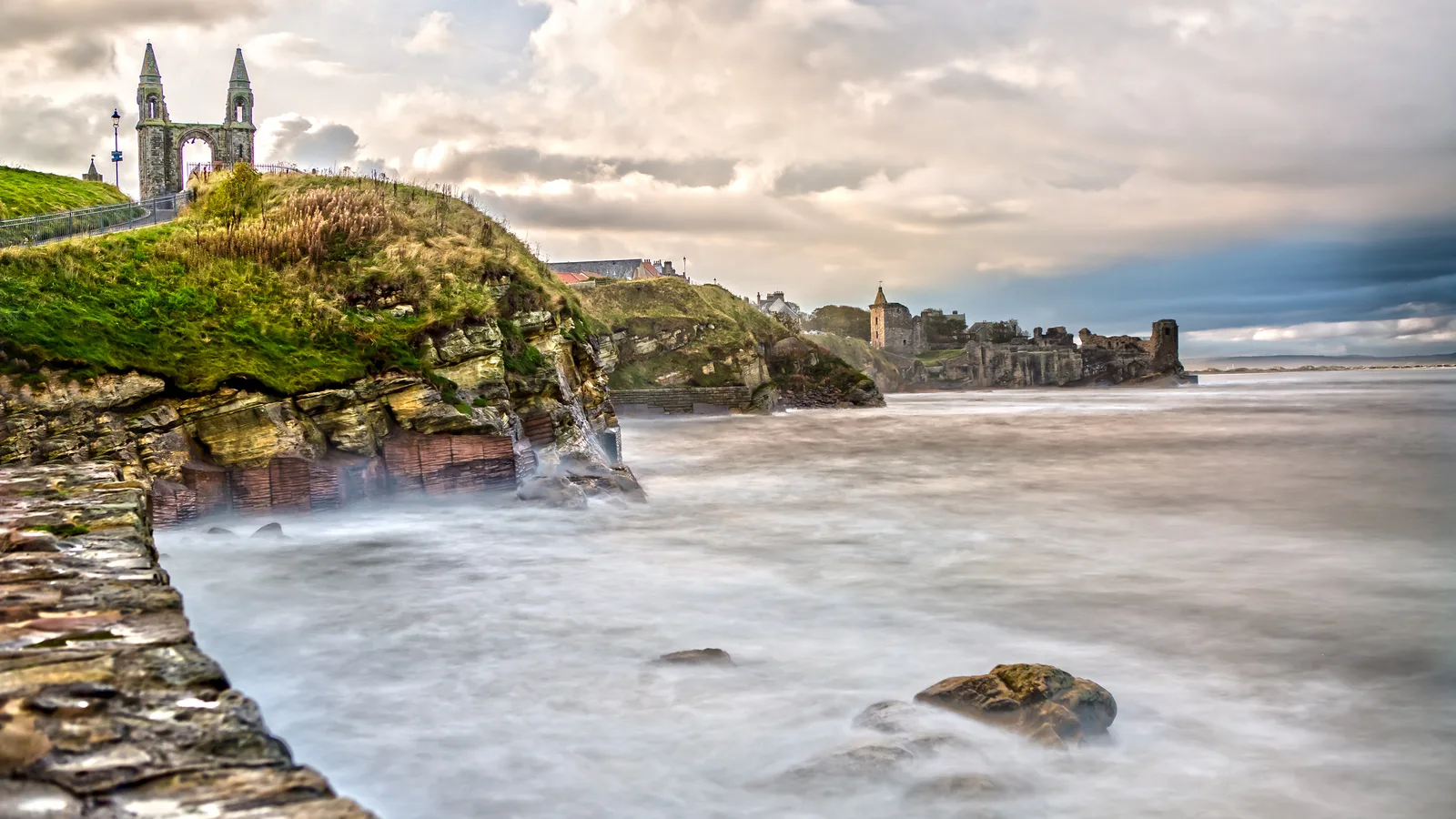
A short walk along the coast, St Andrews Cathedral is the town's great set piece. Work began in 1158 and the building was consecrated in 1318 with Robert the Bruce present. It's the largest church ever built in Scotland, and after a Protestant mob ransacked the interior in June 1559, it was abandoned within two years. What survives is enough to give you the scale: soaring gable ends, the outline of the nave on the grass, and a graveyard where golf's early professionals, Allan Robertson and Old Tom Morris among them, are buried.
Our pick here is the climb of St Rule's Tower, which was a beacon for pilgrims heading to the shrine of St Andrew. It stands 33 metres high and is reached by a stone spiral staircase added in the 18th century. From the top, the whole town lays itself out: the harbour, East Sands, the university spires and the long curve of West Sands in the distance. Both sites are cared for by Historic Environment Scotland, so check their pages before you go for any closures.
Saturday afternoon: university quads and old stones
Walk west along North Street and you'll reach St Salvator's Chapel. St Salvator's College was founded in 1450 by Bishop James Kennedy, and the chapel is the only medieval structure still standing from the original college. Its west tower dates from the 1460s and its spire dominates the skyline as you approach from the west. Outside, look for the initials PH set into the cobbles. They mark the spot where Patrick Hamilton, an early Protestant martyr, was burned in 1528, and the university counts "the curse of Patrick Hamilton's initials" among its traditions.
Then cross to South Street for St Mary's Quad. St Mary's College dates from 1538, the third of the university's three medieval colleges, and its enclosed quad is one of the calmest spots in town. On the way you'll pass Blackfriars Chapel, and at the end of South Street, the West Port frames the road out of the old town.
If the afternoon calls for green space, the St Andrews Botanic Garden covers about 18 acres on the banks of the Kinness Burn at the town's southern edge. It was founded by the university in 1889, originally on a different site within St Mary's College.
Sunday: two beaches, two moods
St Andrews has sand on both sides. West Sands is the big one, a vast sweep of beach that featured in Chariots of Fire. Walk it early and you can continue into the Eden Estuary nature reserve, returning on a track that runs between the golf courses, with the town's buildings lined up on the skyline. It's the one moment of the weekend where you'll walk past the Old Course and the Swilcan Bridge whether you meant to or not. If the golf story tempts you, The R&A World Golf Museum is right there.
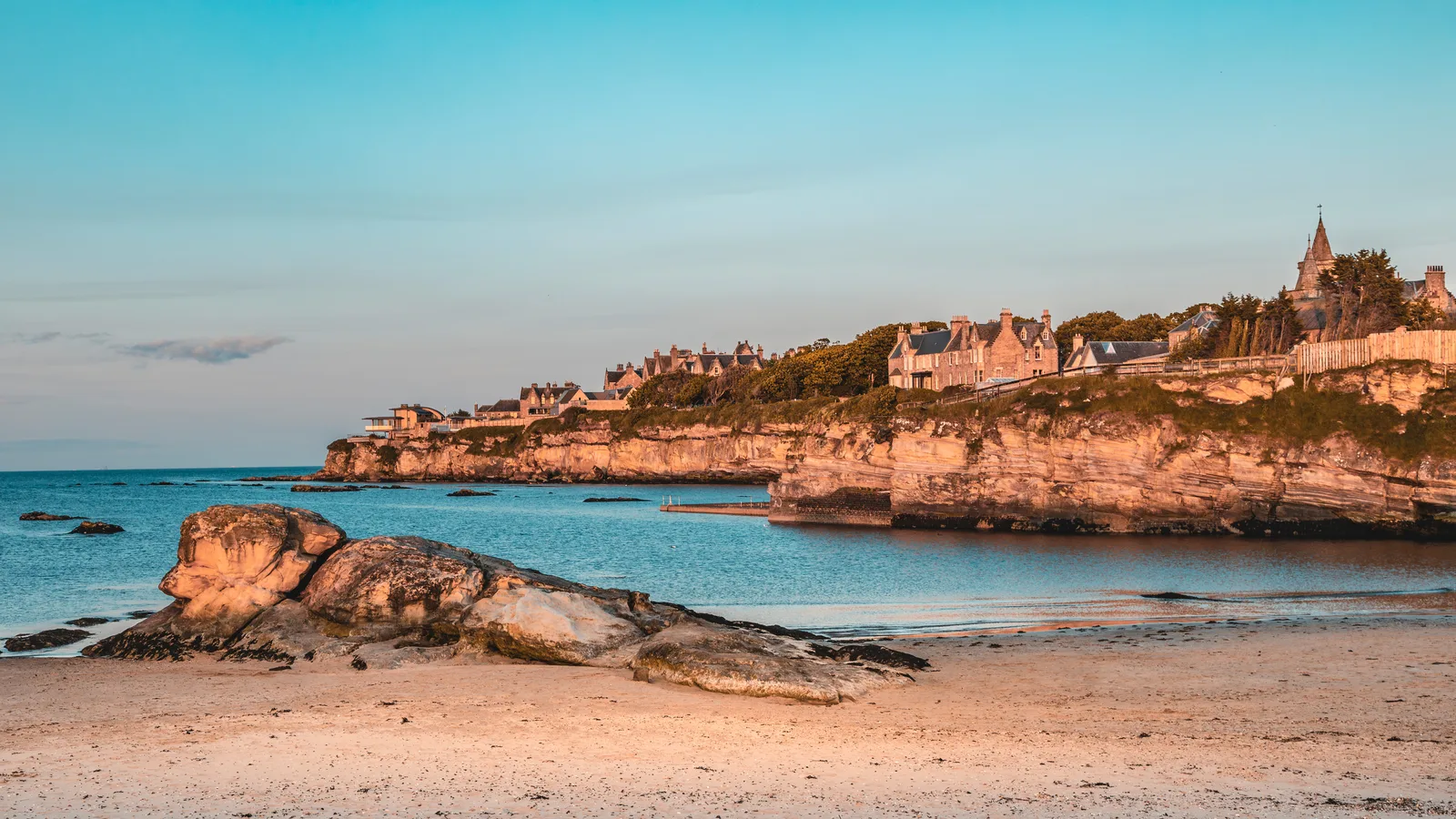
On the other side of town, East Sands is the smaller, more local-feeling beach. Closer to the castle, the rock-edged Castle Sands tidal pool is a favourite of wild swimmers: an atmospheric dip surrounded by jagged black rock, with the castle ruin above. Treat it as a tidal sea pool, not a lido, and check the tide before you go. Families might prefer the St Andrews Aquarium a short walk along the shore.
Where to eat and drink
The town is small enough that you'll stumble on most places. For coffee and a pastry, Taste, Northpoint Café, Dook and Cafe in the Square are all on our list. For an evening pint, add The Rule and St Andrews Brewing Co. on South Street.
Our one non-negotiable is a trip out to Balgove Larder at Strathtyrum, on the edge of town. It's a farm shop, butchery, café and Steak Barn, with meat from its own farm and seasonal events such as summer night markets and Christmas markets. Steak Barn hours vary, so check before you build an evening around it.
Our verdict: if you only have one day
Castle first thing, cathedral and St Rule's Tower before lunch, then the university quads along North Street and South Street. Finish with a long walk on West Sands as the light drops and dinner back in town. It's a compact, walkable day, and it shows you why St Andrews mattered long before anyone hit a ball here.
Plan it
- Getting there: The nearest railway station is Leuchars, about six miles away, on the Edinburgh to Dundee and Aberdeen lines; buses, taxis or a car cover the last stretch. Stagecoach X58, X59 and X60 buses from Edinburgh take about two hours, and the drive is around 1 hour 20 minutes. Edinburgh Airport is about 50 miles away, with the Stagecoach 787 running direct to St Andrews.
- Where to base yourself: Stay in town and you won't need the car. Options run from Rusacks and the Old Course Hotel to Hotel du Vin, Rufflets on the outskirts, or self-catering at Stewart's Resort Lodges.
- When to go: Any season works for the history. Beach days and swims are best in summer; winter weekends are quieter for the castle and cathedral.
- Booking tips: Historic Environment Scotland runs the castle and cathedral, so check its website for closures on the day. Book dinner ahead on weekends, especially during university events and major golf tournaments.
Ready to go? Build a day-by-day plan for St Andrews.
Plan a trip to St AndrewsPlaces in this guide
Frequently asked questions
- What is there to do in St Andrews if you don't play golf?
- Plenty. St Andrews Castle and St Andrews Cathedral (both Historic Environment Scotland), St Rule's Tower, the university's St Salvator's Chapel and St Mary's Quad, the free Wardlaw Museum, the Botanic Garden and two beaches, West Sands and East Sands, fill a long weekend easily.
- Can you go inside the mine at St Andrews Castle?
- Yes. The mine and countermine dug through solid rock during the 1546-47 siege were rediscovered in 1879 and are open to visitors, along with the bottle dungeon beneath the north-west tower.
- How do you get to St Andrews by train?
- There is no station in St Andrews itself. The nearest is Leuchars, about six miles away on the Edinburgh to Dundee and Aberdeen lines, with buses, taxis and car connections into town.
Sources
- historicenvironment.scot/visit-a-place/places/st-andrews-cathedral/history/
- en.wikipedia.org/wiki/St_Andrews_Cathedral
- en.wikipedia.org/wiki/St_Andrews_Castle
- walkhighlands.co.uk/fife-stirling/west-sands.shtml
- news.st-andrews.ac.uk/long-reads/the-quad/
- en.wikipedia.org/wiki/St_Salvator%27s_College,_St_Andrews
- curiousedinburgh.org/2024/06/14/castle-pool/
- st-andrews.ac.uk/visiting/travel/
- st-andrews.ac.uk/museums/wardlaw-museum/
- en.wikipedia.org/wiki/St_Andrews_Botanic_Garden
- welcometofife.com/view-business/balgove-larder
Related guides
Weekend · Belfast
Belfast and the Causeway Coast: Titanic, markets and basalt columns
Two days in the city, from the shipyard where Titanic was built to St George's Victorian market hall and the free Ulster Museum, then a train and bus to the Giant's Causeway.
5 min read
Weekend · Bristol
A Bristol weekend: Brunel's ship, the harbourside, Banksy and the gorge
A weekend in Bristol built around the water: Brunel's iron ship in her dry dock, a free museum of the city, Banksy on the walls and a bridge 101 metres above the Avon.
5 min read
Weekend · The Peak District
A Peak District weekend: Mam Tor, Dovedale, Chatsworth and caves
Two days, two landscapes: gritstone ridges and show caves around Castleton, then limestone dales and a ducal palace further south. Our plan for a weekend in Britain's first national park.
5 min read