Itinerary
Your first trip to Skye: roads, crowds, weather and the big sights
Skye rewards planning. How to get there, drive its single-track roads well, beat the crowds at the Storr and the Fairy Pools, and fit in the Quiraing and Dunvegan Castle.
By VacationGuide Editors · · 6 min read
Skye rewards people who plan and punishes people who wing it. The island's famous sights are spread across long peninsulas, linked by narrow roads, and shared with a lot of other visitors from Easter to the end of September. None of that should put you off. It just means your first trip works best if you think about timing, driving and weather before you think about photographs. Here's how we'd approach it.
Getting onto the island
There are two ways across. The Skye Bridge is a toll-free road bridge linking Kyle of Lochalsh on the mainland to Kyleakin, reached on the A87. It's the route most drivers take, and it means you can arrive on your own schedule.
The more scenic option is the CalMac car ferry from Mallaig to Armadale, a crossing of about 45 minutes. From April to October it sails hourly or every couple of hours; from November to March there are only a couple of sailings a day, so check the timetable carefully if you're travelling off-season.
There's no railway on Skye itself. Without a car, the realistic approach is a train to Kyle of Lochalsh or Mallaig, then a bus or ferry. Glasgow Citylink runs a twice-daily coach from Glasgow, taking around seven hours to Uig, and local Stagecoach buses cover routes on the island, including the 57A and 57C around Trotternish, which serve both the Old Man of Storr and the Quiraing. It's possible, but you'll see more with your own wheels.
Single-track roads: the etiquette that matters
Many of Skye's rural roads are single-track: only wide enough for one vehicle, with signed passing places at intervals. The rules are simple, and following them makes the difference between a relaxed drive and a tense one:
- Pull into a passing place on your left when you meet oncoming traffic, or when a driver behind you wants to overtake.
- If the passing place is on your right, stop opposite it and let the other vehicle use it.
- Give way to traffic coming uphill where you can, even if that means reversing to a passing place.
- Never park in a passing place, however tempting the view.
That last point is the one that causes most of the island's summer frustration. Use car parks, even when you have to pay, and if a car park is full, come back later rather than leaving your car on the verge.
The Trotternish loop: Storr and Quiraing
If you only drive one route, make it the A855 around the Trotternish peninsula north of Portree. It strings together two of Skye's most extraordinary landscapes, both made by the same geology: thick layers of lava spread over weaker sedimentary rock, which gave way in a series of enormous landslips.
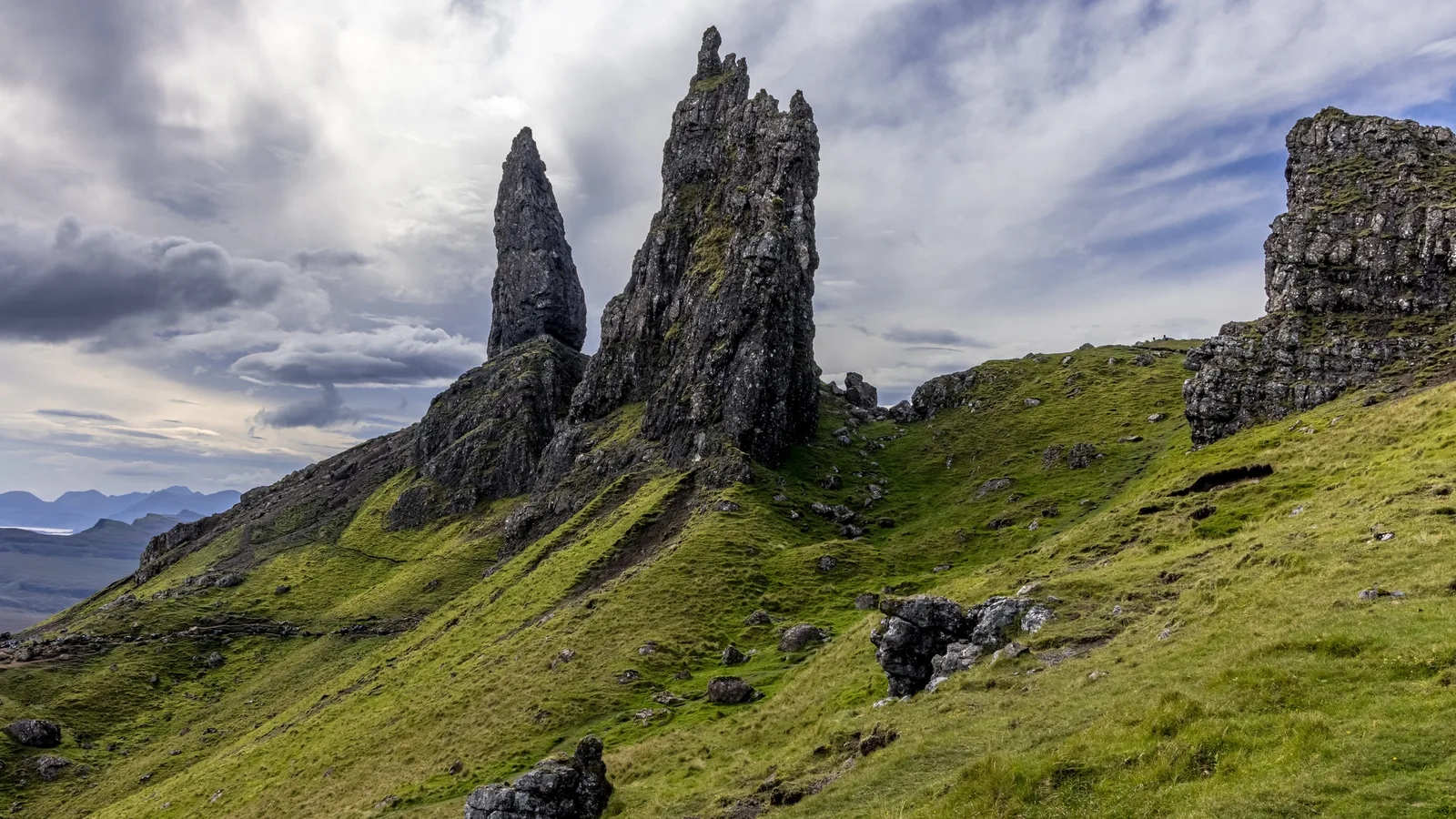
The Old Man of Storr is the first stop, about 6.8 miles north of Portree. The Old Man himself is a 55-metre pinnacle of basalt below The Storr, the highest summit on the Trotternish ridge at 719m. The out-and-back walk is 3.8km. Most of it is on a good gravel path, though some sections are steep with rough stone steps, and the top can be muddy when wet. Allow about 45 minutes to the foot of the pinnacle and 30 to 40 minutes back down, plus time to stand and stare. The car park beside the road has 140 spaces, which sounds like a lot until a summer morning proves otherwise.
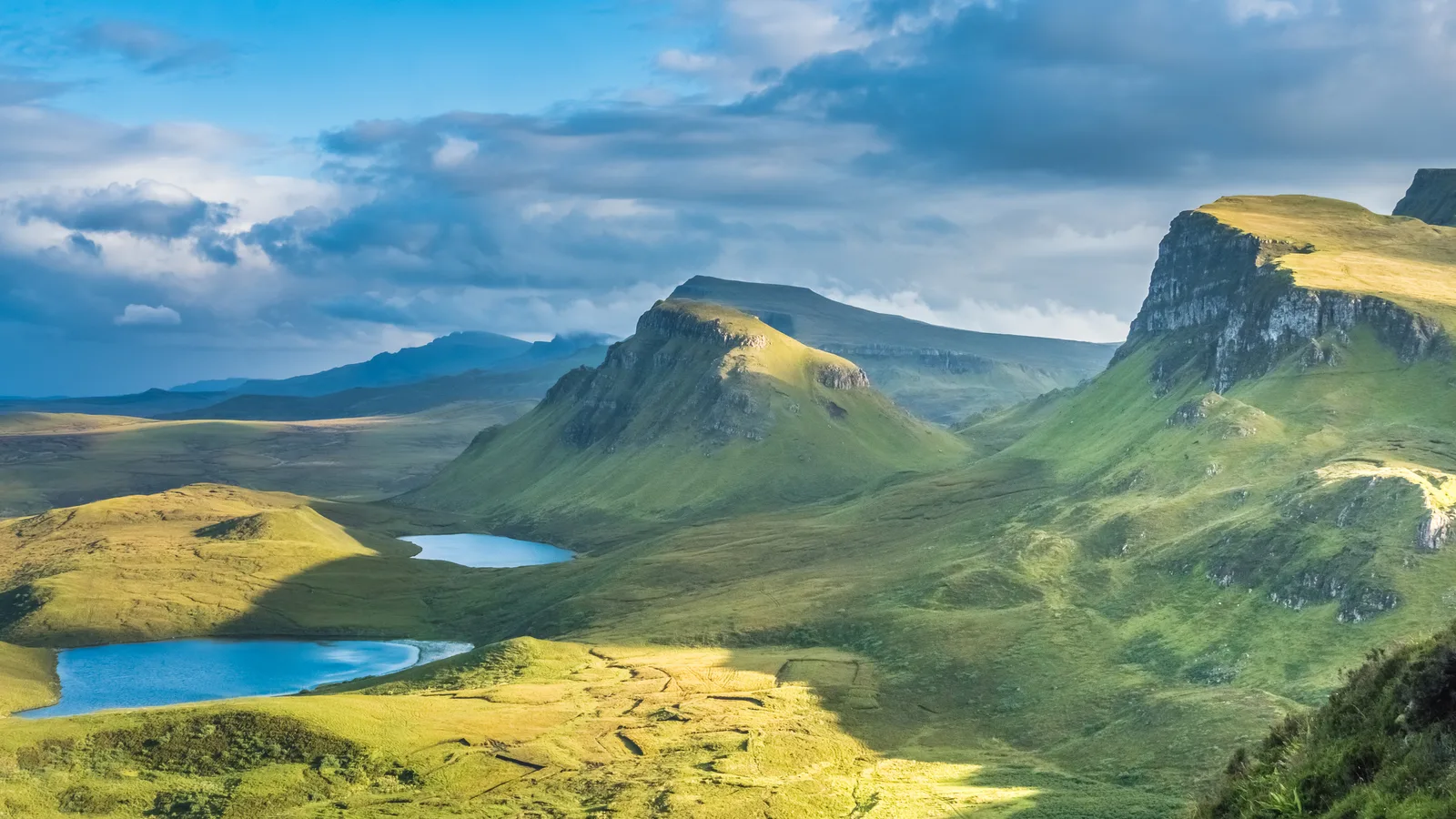
Further round the loop is The Quiraing, on the eastern face of Meall na Suiramach, the northernmost summit of the Trotternish escarpment. It's a hollow ringed by a high rock rampart, with features that have earned names of their own: the Table, a raised plateau about the size of a football pitch; the Needle, a jagged pinnacle 37 metres high; and the Prison, a rock mass that looks like a medieval keep. The poet Alexander Smith called it "a nightmare of nature", which tells you more about the drama than any photo. Walking in is the way to appreciate it, but go prepared for weather that can turn quickly on an exposed ridge.
The Fairy Pools and the Cuillin
On the other side of the island, in Glenbrittle near the village of Carbost, the Fairy Pools are a chain of clear, cold pools and waterfalls beneath the Cuillin mountains. They're free to visit at any time. From the car park it's about 2.4km on a gravel path, with bridges along the way, to the largest waterfall, and smaller pools continue further up.
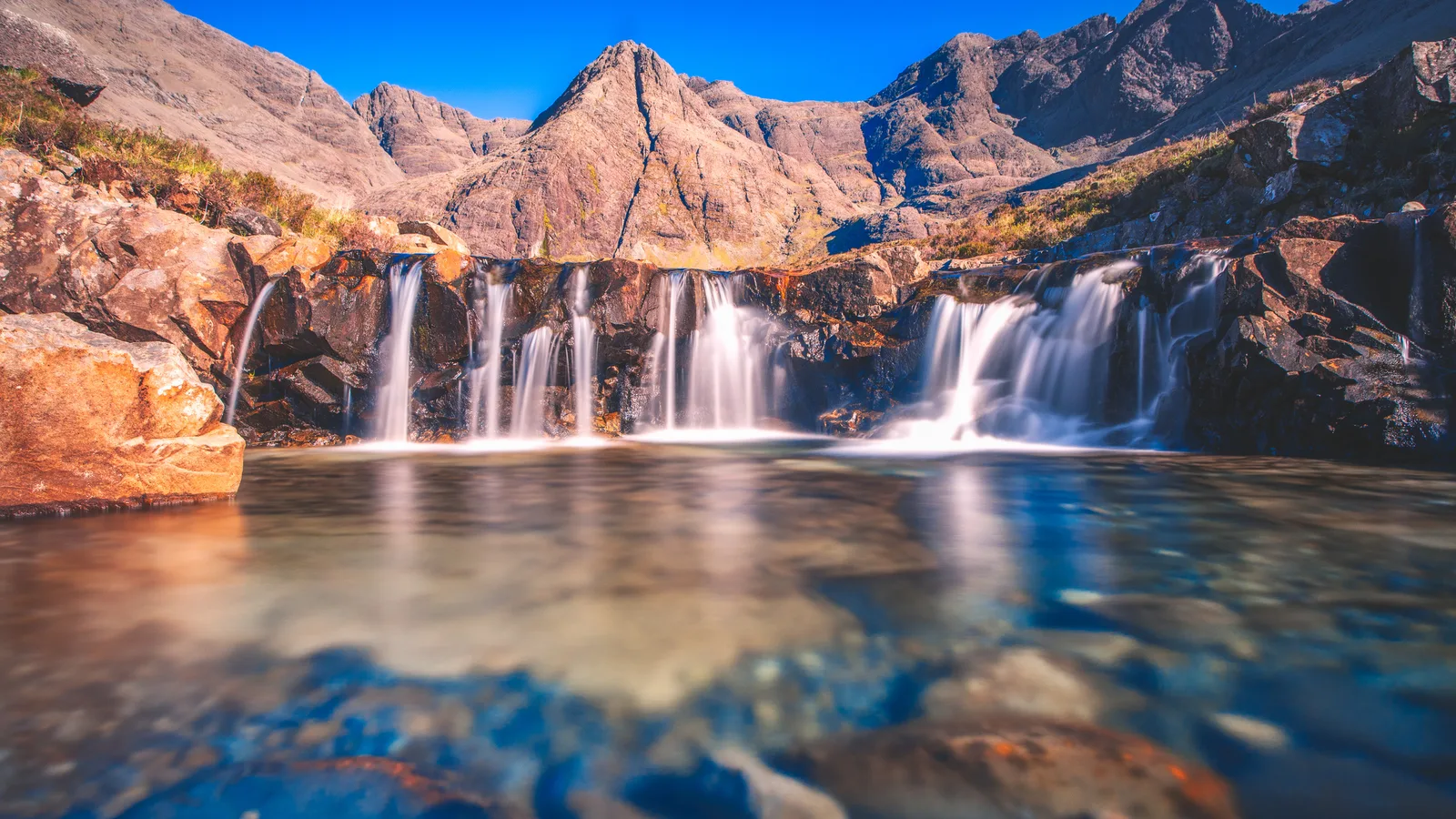
The water is icy mountain water, so if you're planning a swim, a wetsuit is sensible. The bigger issue is access. The car park is owned by the Minginish Community Hall Association and leased to an operator that collects parking charges, and the single-track road from Carbost gets very busy in July and August. The local advice is clear: if traffic is heavy, come back another time. That applies doubly if you're in a motorhome.
Dunvegan Castle
For a change from rock and water, head west to Dunvegan Castle on the shore of Loch Dunvegan. It's described as Scotland's oldest continuously inhabited castle and has been the seat of the MacLeod chiefs for more than eight centuries. Inside you'll find clan treasures including the Fairy Flag; outside are five acres of formal gardens dating from the 18th century, with a water garden, rose garden, walled garden and woodland walks.
The castle and gardens open seasonally, from late March to mid-October, and from late March to the end of September short boat trips run from the jetty below the castle to see the local seals, first come, first served, and weather permitting. It makes a good wet-weather fallback, and a natural lunch stop between sights.
Our verdict: if you only have two days
Day one: Trotternish. Start early at the Old Man of Storr, continue round the A855 to the Quiraing, and come back to Portree for the evening. Day two: Dunvegan Castle in the morning, the Fairy Pools in the afternoon if the road and car park look manageable, or another time if they don't. Don't try to cram both peninsulas into one day. Skye's distances look small on a map and feel long on single-track roads.
Crowds and weather: how to cope
The busiest period runs from Easter to September, and the honeypot sights fill up fast. The single most useful thing you can do is go early: car parks at the Storr and the Fairy Pools are far easier first thing. Build slack into your plans so you can swap days around the weather, and treat every forecast as provisional. Pack waterproofs and proper footwear even for short walks, since paths like the Storr's can get muddy and the upper sections carry a risk of rockfall.
Plan it
- Getting there: By road over the toll-free Skye Bridge from Kyle of Lochalsh, or by CalMac ferry from Mallaig to Armadale (about 45 minutes). The nearest stations are Kyle of Lochalsh and Mallaig; Glasgow Citylink coaches run from Glasgow to Uig.
- Where to base yourself: Portree is the main village, with the most accommodation, shops and the tourist information office. Broadford and Glenbrittle have camping, hostels and self-catering options too.
- Best time of year: Late spring and early autumn balance longer days with fewer crowds. Some accommodation closes in winter, and ferry sailings are reduced from November to March.
- Booking tips: Book accommodation well ahead for any stay between Easter and the end of September. Car hire is available in Portree and Kyle of Lochalsh, but it can be expensive, so arrange it before you arrive.
Ready to go? Build a day-by-day plan for the Isle of Skye.
Plan a trip to the Isle of SkyePlaces in this guide
Frequently asked questions
- How do you get to the Isle of Skye?
- By road over the toll-free Skye Bridge from Kyle of Lochalsh, or on the CalMac car ferry from Mallaig to Armadale, which takes about 45 minutes. There is no railway on Skye; the nearest stations are Kyle of Lochalsh and Mallaig.
- How long is the Old Man of Storr walk?
- The out-and-back walk is 3.8km. Allow about 45 minutes up to the foot of the pinnacle and 30 to 40 minutes back, plus stops. Parts are steep with rough steps and can be muddy.
- When is Dunvegan Castle open?
- The castle and gardens open seasonally, from late March to mid-October, with seal boat trips from late March to the end of September, weather permitting. Check the castle's website before you travel.
Sources
- en.wikivoyage.org/wiki/Skye
- highland.gov.uk/news/article/15280/police_scotland_are_once_again_issuing_advice_for_those_travelling_on_the_nc500_this_summer
- isleofskye.com/skye-guide/top-ten-skye-walks/old-man-of-storr
- en.wikipedia.org/wiki/Quiraing
- dunvegancastle.com/fairy-pools
- dunvegancastle.com/visitor-information/
- visitheritage.co.uk/inspiration/things-to-do/dunvegan-castle-gardens/
Related guides
Itinerary · Bath
Bath in a day: Roman Baths, the Abbey, Pulteney Bridge and the Crescent
One day, all on foot: from the steaming Roman Baths and Bath Abbey to Pulteney Bridge, the Circus and the Royal Crescent, with a Sally Lunn bun along the way.
5 min read
Itinerary · The Cotswolds
The Cotswolds village by village: Broadway Tower, Sudeley and Blenheim
Follow the Cotswold Way from Chipping Campden's Market Hall to Broadway Tower and Katherine Parr's grave at Sudeley, then finish at Blenheim in Capability Brown's parkland.
5 min read
Itinerary · Inverness and Loch Ness
Inverness and Loch Ness in two days: castles, cairns and a battlefield
Two days, one river, one very deep loch. Our plan for Inverness takes in Culloden, the Clava Cairns, Urquhart Castle and a boat on Loch Ness, with time left for the city itself.
5 min read